Exploring Neural Network Applications in Real-Time Strategy Game Balancing Systems
Nils Meier · Aug 25, 2026
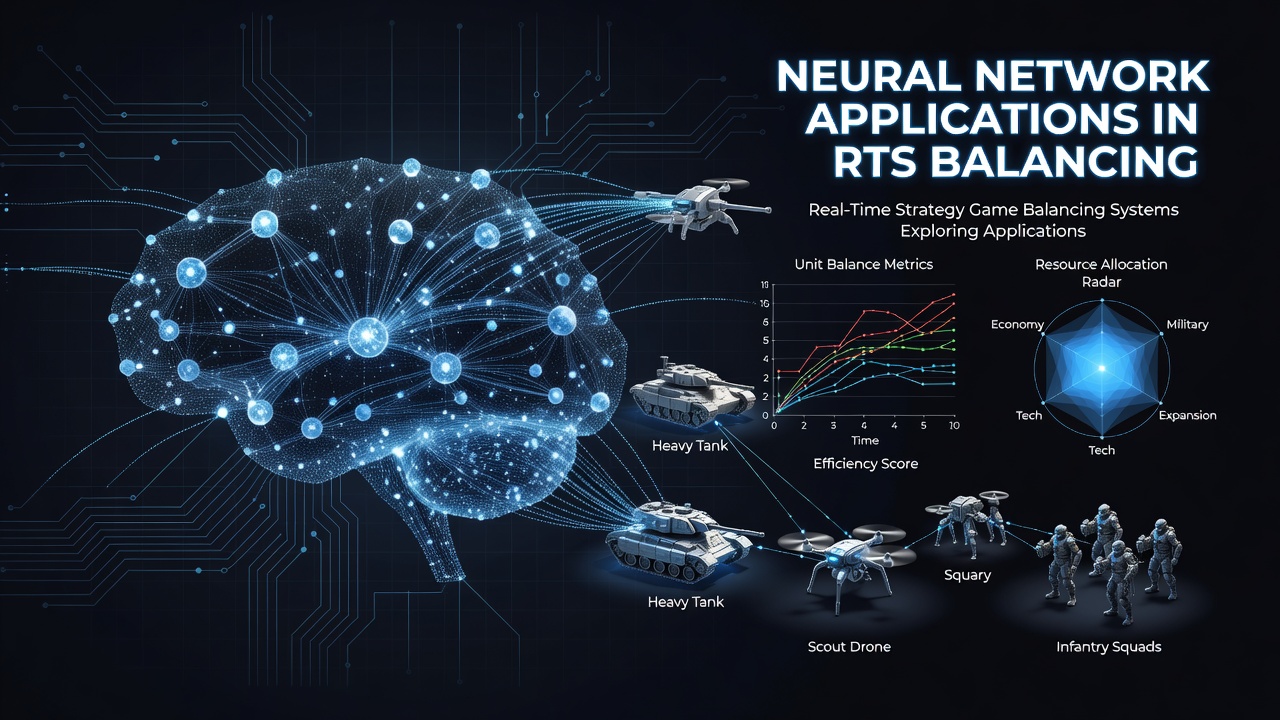
Exploring Neural Network Applications in Real-Time Strategy Game Balancing Systems
Real-time strategy games demand precise balance across units, resources, and maps because small imbalances shift competitive play dramatically, and developers have turned to neural networks to analyze vast datasets of player matches in order to predict and adjust these variables before patches reach the public. Neural networks process inputs from millions of games simultaneously, identifying patterns in win rates that traditional spreadsheets overlook, while researchers at institutions across North America and Europe continue refining these models for live environments.
Training begins with labeled match data that includes unit compositions, map layouts, and outcome statistics, after which convolutional layers detect spatial relationships on the battlefield and recurrent layers track how advantages evolve over time, allowing the system to simulate thousands of hypothetical scenarios in minutes rather than weeks of manual testing. This approach has appeared in titles where developers release weekly balance patches based on neural predictions rather than community complaints alone.
Core Mechanisms Behind Neural Balancing Tools
Feedforward networks handle static evaluations such as individual unit strength comparisons, whereas transformer architectures process entire game states as sequences, learning contextual dependencies that emerge when multiple factions interact on procedurally varied terrain. Data pipelines feed anonymized telemetry from ranked ladders directly into these models, which then output suggested multiplier changes for damage values or build times, and these outputs undergo human review before implementation.
Reinforcement learning agents trained within the same environments serve as test opponents, revealing edge cases where a seemingly balanced unit dominates under specific resource conditions that human testers rarely encounter during short play sessions. Observers note that such agents accelerate iteration cycles because they play around the clock without fatigue.
Deployment Examples Across Major Titles
One studio integrated a graph neural network that models unit interactions as nodes and edges, updating balance parameters in response to live server data collected during peak evening hours in multiple time zones. The model flagged an underused infantry type whose effectiveness dropped sharply once opponents reached tier-three economy thresholds, prompting a targeted adjustment that equalized match durations across skill brackets.
Another project applied variational autoencoders to compress high-dimensional replay files into latent spaces, surfacing clusters of strategies that consistently produced lopsided results on certain maps, and developers used these clusters to redesign terrain features rather than nerfing individual units. In August 2026 several studios announced synchronized updates that incorporated these neural outputs, aligning balance changes across regional servers within the same maintenance window.
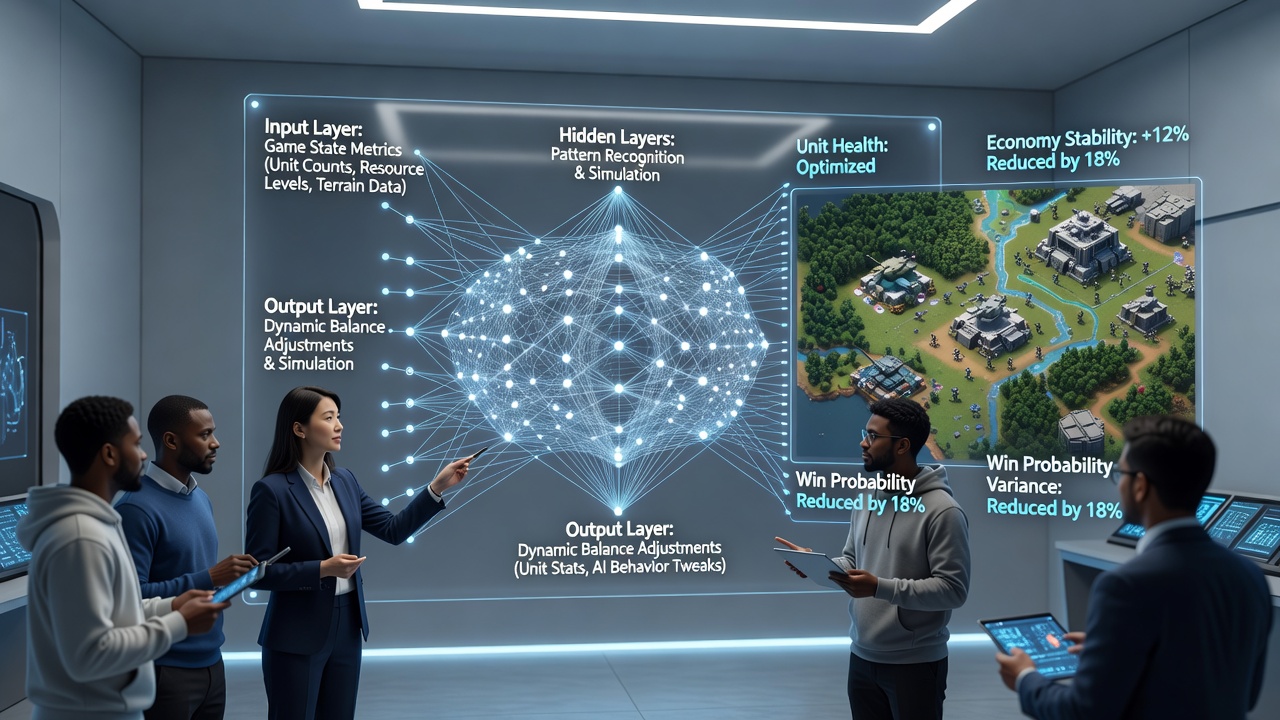
Academic collaborations have supplied open datasets that smaller teams leverage without building their own collection infrastructure from scratch. A joint effort between Canadian and German universities released anonymized match logs covering five years of competitive play, enabling independent researchers to train lighter models suitable for indie budgets while larger publishers continue scaling toward cloud-based inference that updates mid-match parameters in experimental modes.
Technical and Operational Considerations
Latency requirements dictate that inference must complete within milliseconds when systems operate during active matches, leading engineers to prune networks and quantize weights so predictions run on existing game servers without additional hardware. Offline training occurs on GPU clusters that ingest nightly batches of new matches, retraining only the affected layers to preserve earlier learned features about core mechanics.
Validation protocols compare neural suggestions against historical patches whose effects are already known, measuring how closely predicted win-rate shifts match actual post-patch statistics. Discrepancies trigger further data collection focused on underrepresented player cohorts or newly released content expansions.
Future Directions and Industry Standards
Industry groups such as the International Game Developers Association have begun drafting guidelines for transparent documentation of neural balancing decisions, requiring studios to publish summaries of training data sources and model architectures. Parallel work at the Association for Computing Machinery explores standardized benchmarks that compare different network topologies on shared RTS testbeds, fostering reproducibility across research labs on multiple continents.
These standards emerge as neural methods move from experimental prototypes into production pipelines, where explainability tools highlight which input features most influenced each balance recommendation and allow designers to trace unexpected outcomes back to specific training examples.
Conclusion
Neural network applications continue expanding within real-time strategy balancing workflows because they process scale and complexity beyond manual methods, yet they operate alongside human oversight that interprets outputs within broader design intent. Ongoing refinements in model efficiency and data governance will determine how widely these tools spread among studios of varying sizes, while shared benchmarks and documentation practices support consistent evaluation across the field.